


Kindergarten Screening and Information for Parents
Kindergarten Screening
Research has repeatedly demonstrated an important connection between children’s listening and speaking skills and learning to read and write. These skills are important for a child’s school and social success.
Saskatoon Public Schools speech-language pathologists (SLPs) use an embedded screening procedure. Instead of pulling students out of the classroom to be screened individually by the school SLP, an embedded screening model is used, including brief in-classroom observations and conversations with students.
SLPs work with kindergarten teachers to identify those demonstrating communication difficulties.
If you have questions about the embedded speech/language screening model, don't hesitate to contact your school SLP.
Please note that the embedded screening model does not apply to schools supported by the SPS Foundation Early Learning Equal Start SLPs.
Speech and Language Information for Parents
By the time your child enters kindergarten, they should be able to produce certain sounds while other sounds will emerge by grades one, two, and three. Below is a visual representation of what English sounds are expected to emerge by each age. Other languages spoken in the home may alter the developmental timeline of the English speech sounds.
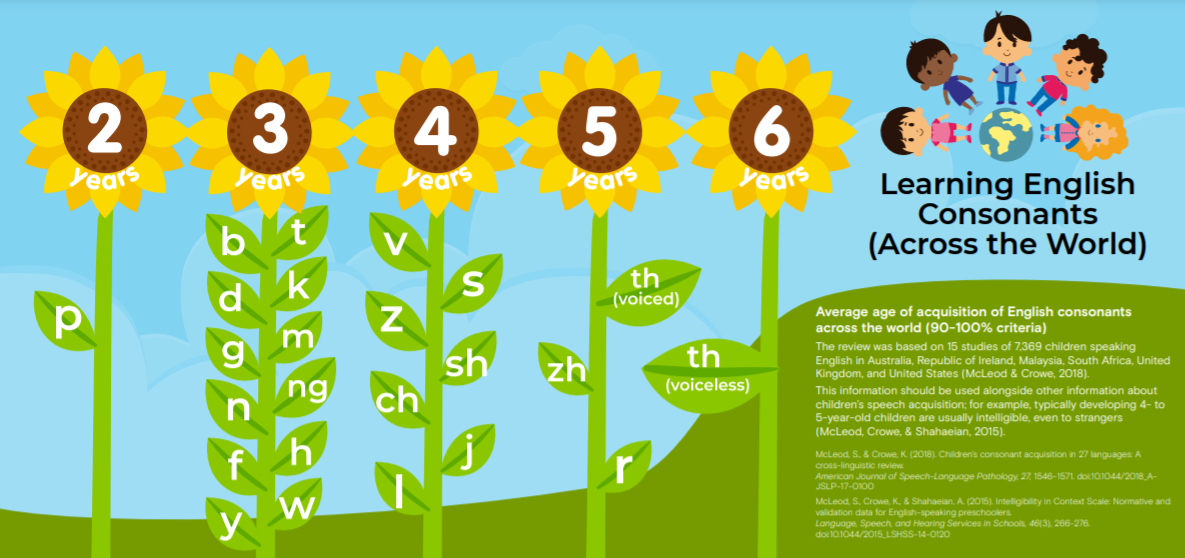
How you can help: When your child mispronounces a word, agree with the content of the child's statement, so that he/she feels heard and understood, then repeat the word accurately (e.g., if your child said "look at the tar", respond by saying something like, "Yes, I see the star").
Expressive Language Skills
By the time your child enters kindergarten he or she should be able to:
- Name common objects and actions
- Use describing words
- Explain what words mean
- Use prepositions including "in, on, under, beside, behind, in front of"
- Speak in complete sentences that are usually grammatically correct
- Ask and answer questions including "who, what, where, why"
- Talk about or describe events
- Remain on-topic during a conversational turn
Ways to help your child communicate effectively: Comment on things your child tells you. Use phrases such as “Tell me more” to encourage your child to expand his or her verbal expression. Show your child how to use better sentences by first agreeing with the content of his/her statement so that he/she feels heard and understood. Then rephrase the sentence, emphasizing the correct form (e.g., if your child said “Sandy sleeped all by hisself,” you can say, “Yes, Sandy slept all by himself.” Provide your child with feedback if he/she is unclear or off-topic.
Receptive Language Skills
By the time your child enters kindergarten he or she should understand the following:
- Directions or instructions that include two or three steps (e.g., “Please get your backpack and shoes and put them by the door.”)
- Many descriptive words such as ‘top/bottom’, ‘loud/quiet’, ‘longest/shortest’
- Prepositions including ‘in, on, under, beside, behind, in front of’
- Your child should be able to understand a short story
- Your child should be able to understand and point to some basic colours
Ways to help increase your child’s understanding: Take your child to new and different places. Talk to your child about things you see and explain what is happening. Encourage your child to help with activities around the home. Explain and describe things as you do them together, e.g., “The cans go on the top of the shelf.” Read a variety of books. Talk about things you see in the pictures and take turns story-telling.